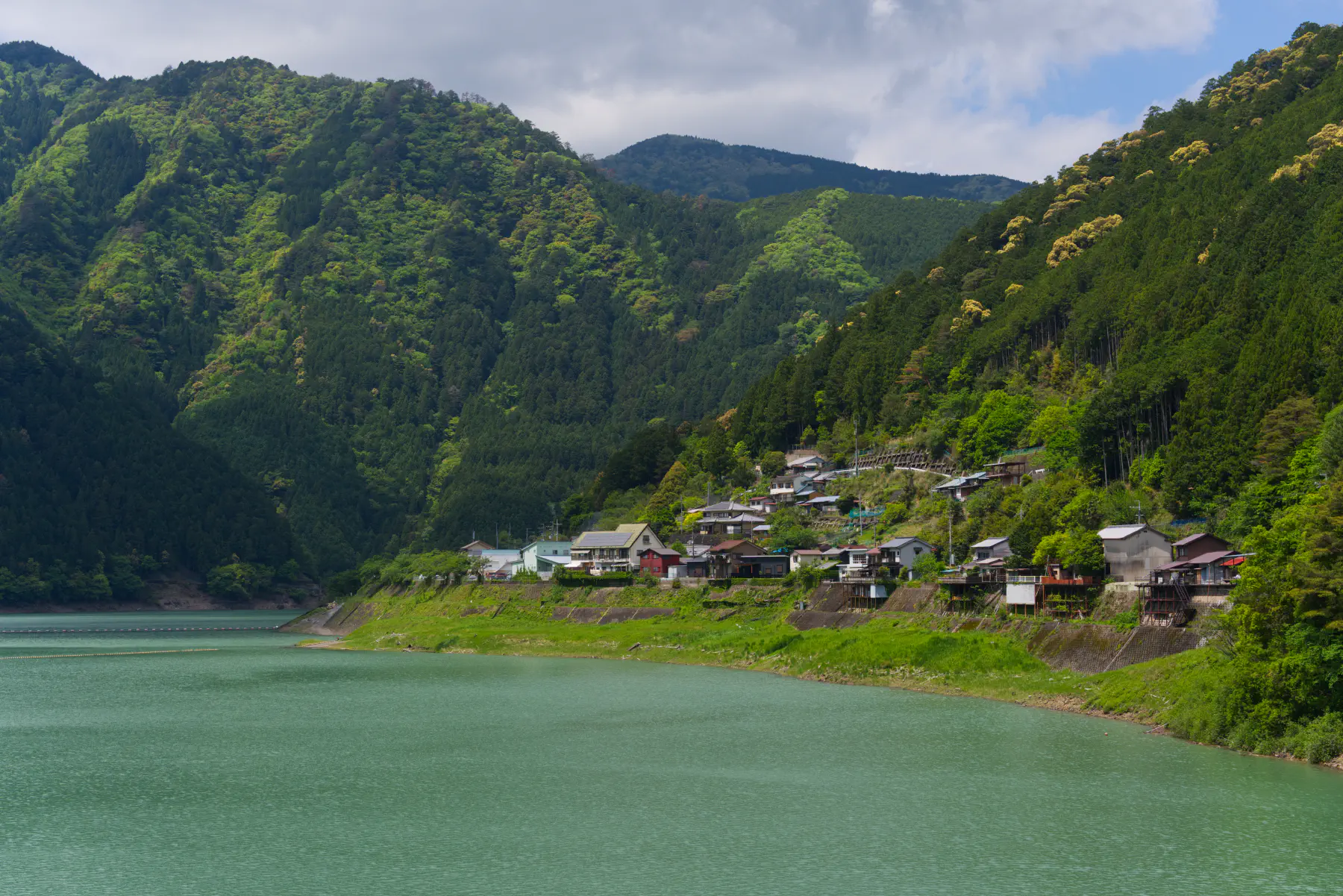
Welcome to Golden Week, Japan’s largest holiday period. Be prepared for millions of people traveling all over the country, public transportation being filled to the brim, and hotels, even with the prices increased, fully booked everywhere. So what better time than to travel ourselves?
You might remember me ending the last post (Welcome to Kobe) by saying the following:
Providing the thing we need is not yet fully booked.
Turns out, the thing we required was, in fact, fully booked. The plan was as follows: rent a small camper van and drive around the Wakayama Peninsula. Hotels are usually much pricier or booked out during Golden Week, so having a camper van would have provided us with a backup. But after asking around four different rental places, everything was rented out.
So instead, we just rented a normal car and booked all the hotels in advance. A little less flexibility, but the reassurance that we do not have to sleep in the car.
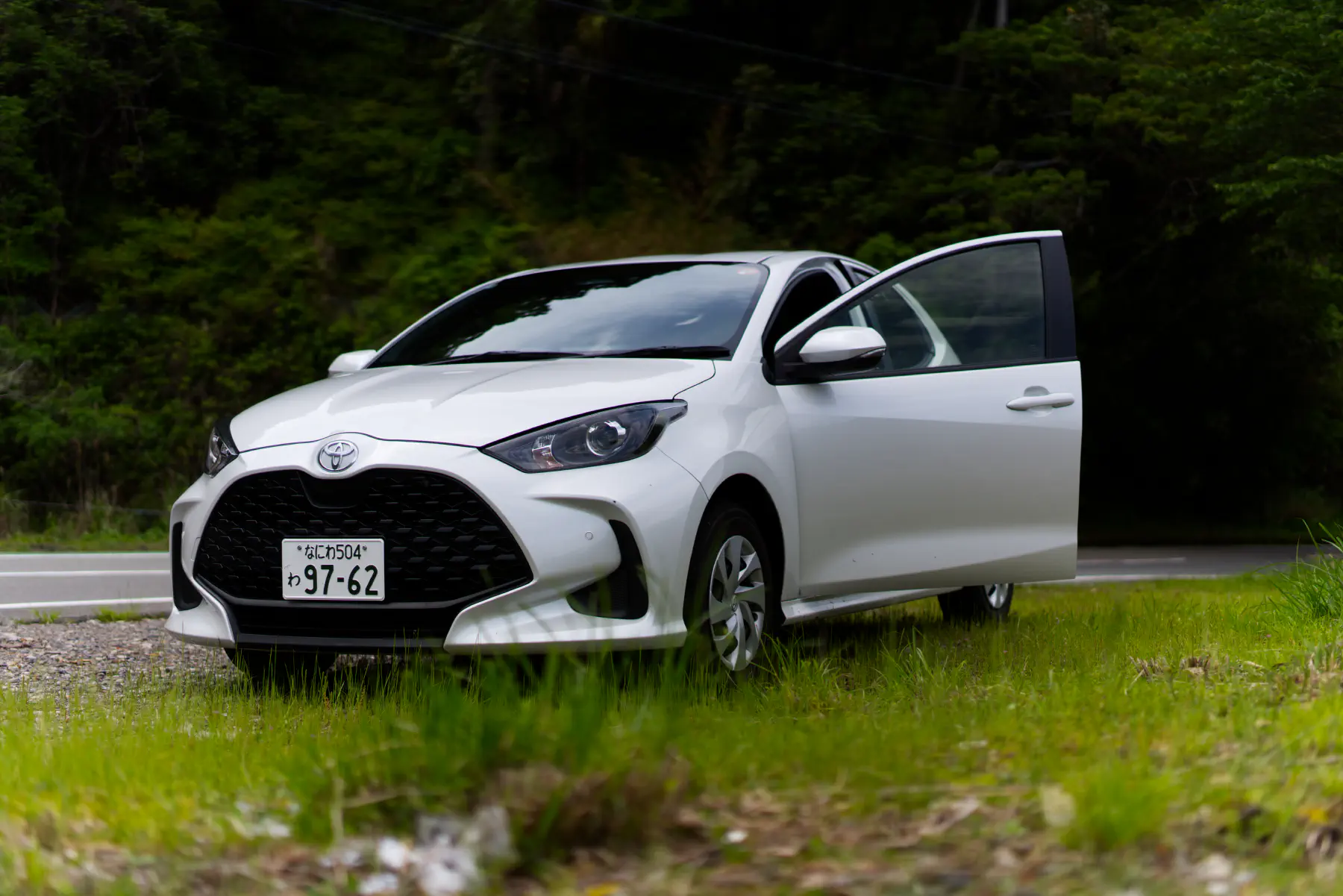
ILCE-7M4, FE 55mm F1.8 ZA, f1.8, ISO 100, 1/6400
It’s now Saturday, May 2nd, and we have a 1.5-hour train ride before we even get to our car rental shop. There were some other shops that still had a smallish car, but the one we chose was in Matsubara, already fairly close to our first destination: Mount Kōya.
Mount Kōya (高野山)—The Center of Shingon Buddhism
Mount Kōya is the birthplace of the Shingon sect of Japanese Buddhism, one of the five major sects in Japan. It was founded by the Japanese monk Kūkai, who traveled to China and brought back the teachings and scriptures of Chinese Esoteric Buddhism. Followers of this sect refer to Kūkai as Kōbō-Daishi (弘法大師, lit. Vast Principle Big Teacher). Don’t worry, there won’t be a test at the end of this post.
Naturally, Mount Kōya is full of Buddhist temples, and in some of them, you can stay overnight. That’s precisely what we did for two nights, from Saturday until Monday.
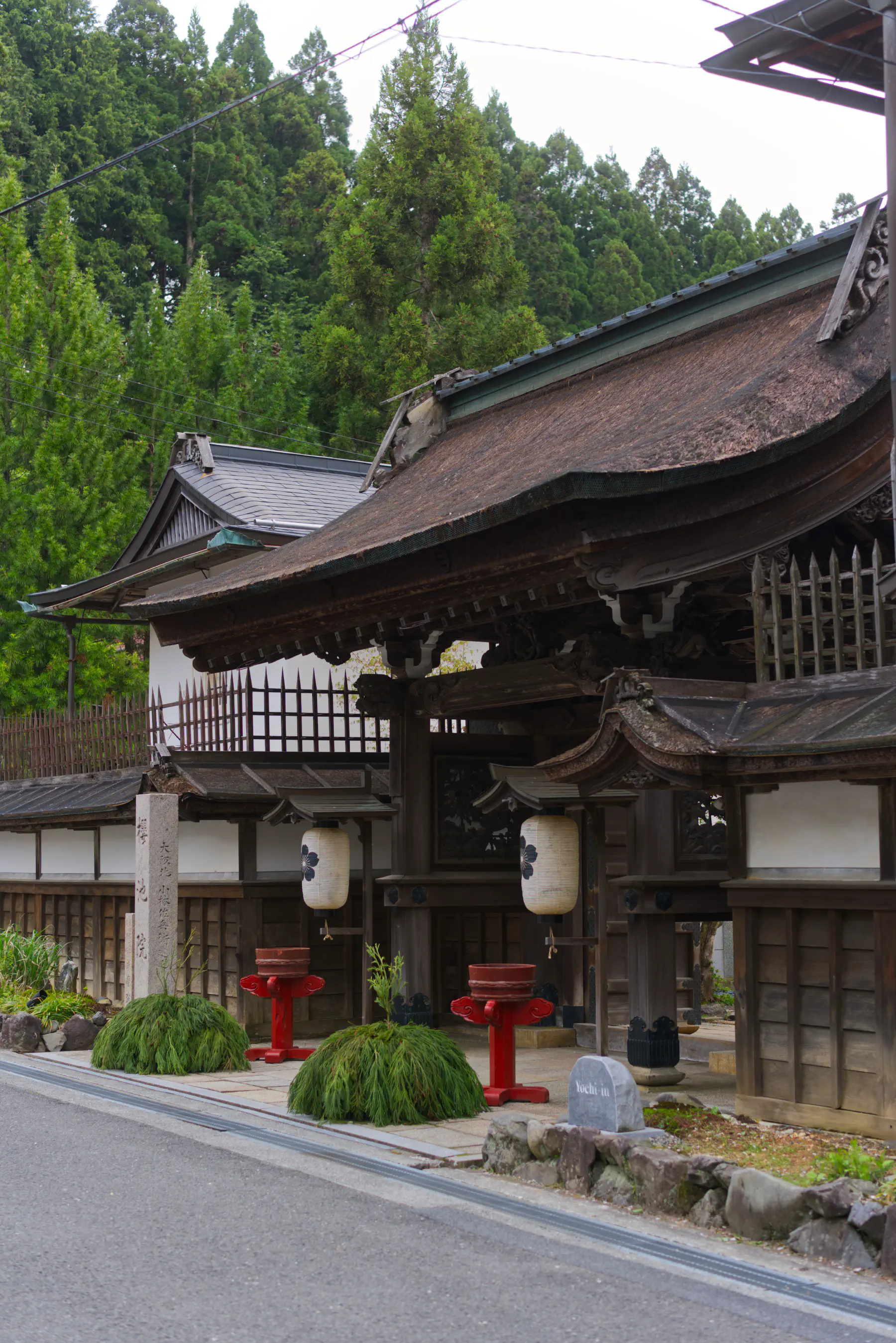
ILCE-7M4, FE 55mm F1.8 ZA, f3.2, ISO 100, 1/100
Staying in a temple is a bit different from a regular hotel but not as different as a traditional Japanese inn, a ryokan. The room was super simple. A small table, two futons, a window, and some wall decoration. The bathroom and toilet were shared, but we hardly encountered the other guests at the same time.
What was different was the food. Buddhist cuisine is vegetarian, almost vegan, and devoid of what they called high-energy foods. We also were able to partake in a Buddhist morning ritual, offering incense and chanting mantras. While I’m not religious myself, I quite enjoyed the experience of it. It was very serene, creating a comfortable space to let your thoughts wander.
But I’m jumping ahead. The first evening, after dinner, we went on a night walk to the Okunoin Cemetery, the largest cemetery in all of Japan. This cemetery houses over 200'000 graves of famous people, regular people, and even companies. Yes, you read that correctly. The very first one was Panasonic, built by its founder in 1938. Nowadays there are countless others, such as Nissan, a memorial in honor of termites killed by an extermination company, and even a company grave that features a model of the Saturn V rocket. Although that company did not have any connection to this mission at all.
While walking through the cemetery, our guide, who luckily spoke perfect English, explained to us the various graves and statues, their history, and their connection to Buddhism. He told us that this is his way to combat the aptly named “temple fatigue”, which I am well acquainted with myself. Especially in Japan, where there are countless shrines and temples scattered throughout the country, they will quickly seem as if they all look the same. It’s small details and stories that this guide shared with us that will make a specific temple stand out.
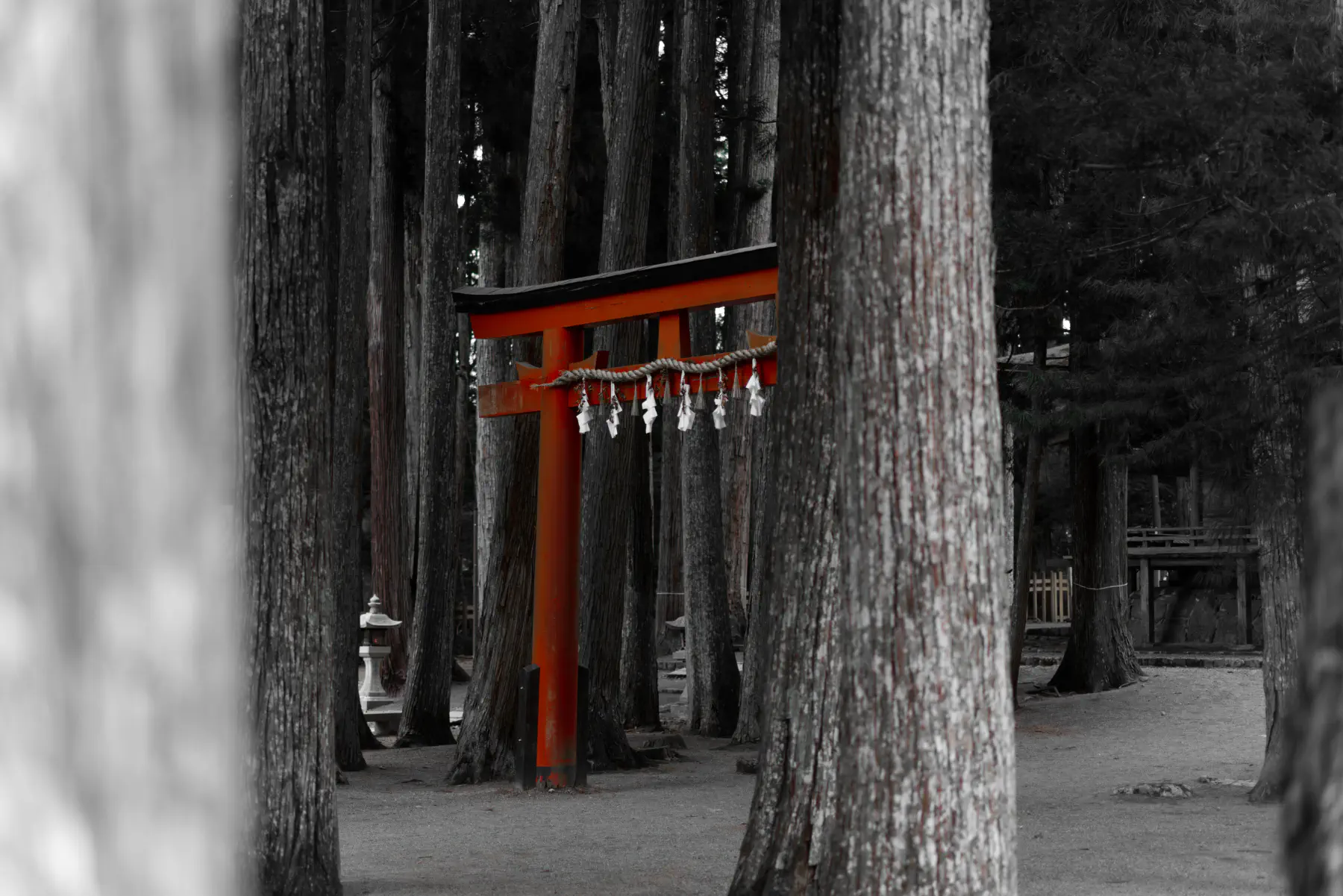
ILCE-7M4, FE 55mm F1.8 ZA, f1.8, ISO 100, 1/160
The tour had three parts. The walk through the new part of the cemetery, the old part, and, at the end of that, the mausoleum of Kōbō-Daishi himself. At the mausoleum itself, pictures and videos were prohibited. The main temple was filled with thousands of lanterns, all emitting a warm light. It is said that two of these have been burning for over 900 years without pause.
Right behind the main temple is the mausoleum itself. After chanting a mantra together with the guide, he explained that it is said that Kōbō-Daishi has not died but has entered a meditative trance as he awaits the Buddha of the future.
It is now Sunday, and after our morning ritual and breakfast, we set out ourselves to explore the rest of Mount Kōya.
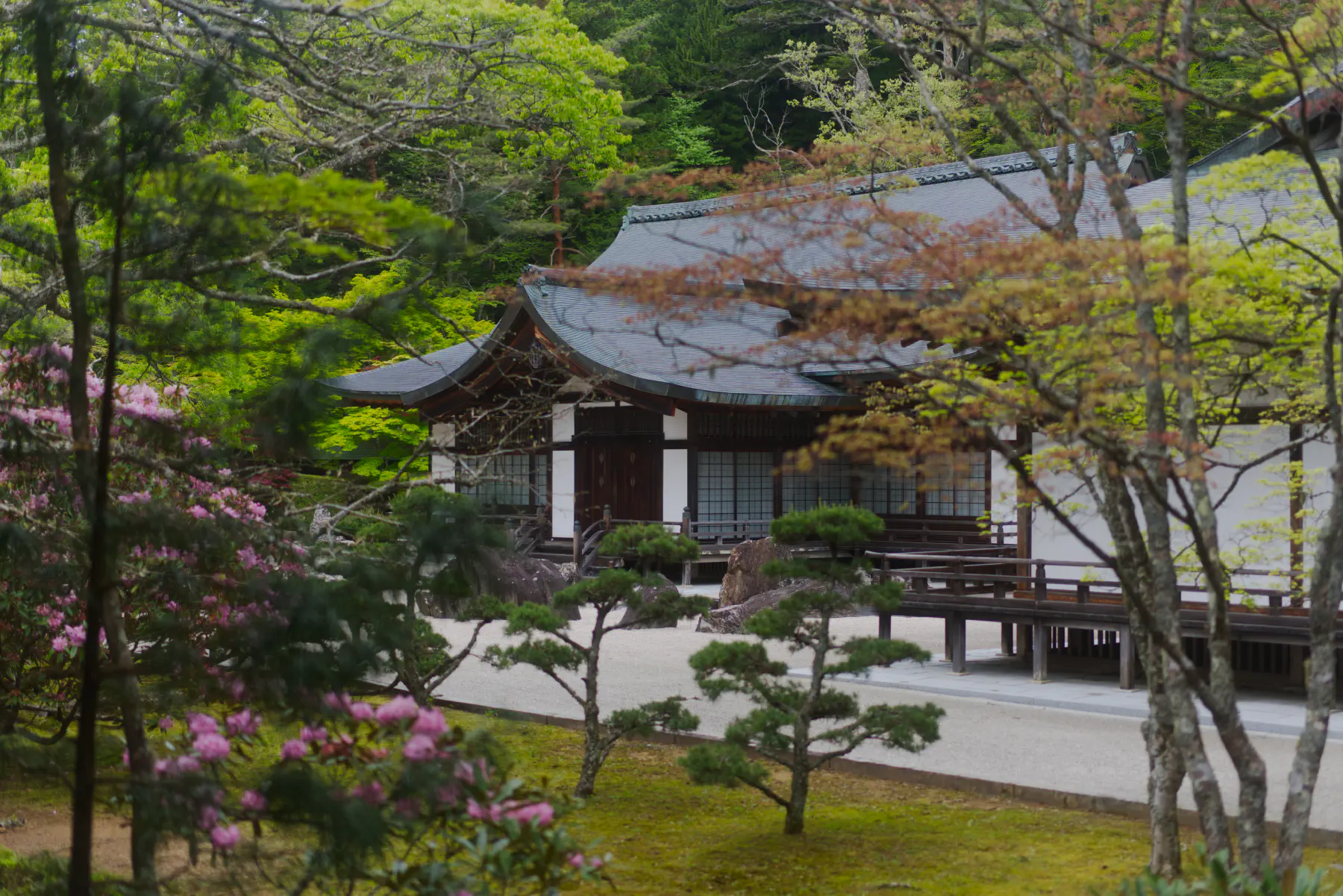
ILCE-7M4, FE 55mm F1.8 ZA, f1.8, ISO 100, 1/640
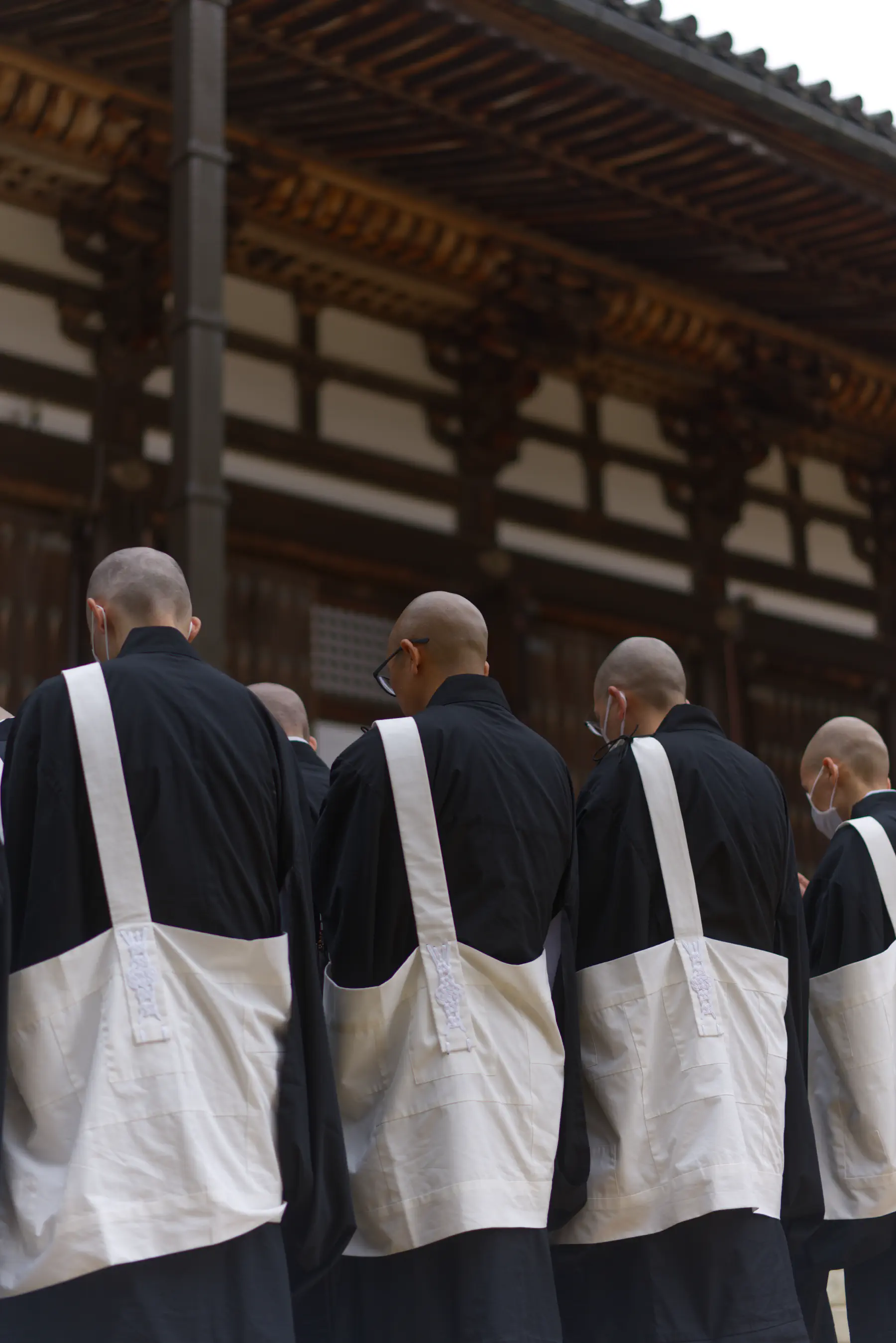
While we were there, a special Buddhist ceremony called Kechien Kanjo was held. This ritual is specific to Shingon Buddhism and allows the participant to form a spiritual connection with a Buddha. The participant is blindfolded, guided in front of a mandala, and instructed to throw a flower onto it. The part where the flower lands shows which Buddha they are now connected with.
Of course, we did not see any of this, as the event itself was conducted inside a temple. I think we could have “donated” around 5'000 yen to enter, but there were many other visitors. We chose to watch from the outside and snap a few pictures whenever they moved from temple to temple. With the ceremony still going on and people crowding in this single spot, we took this chance to visit the rest of Mount Kōya in peace.
ILCE-7M4,
FE 55mm F1.8 ZA,
f1.8, ISO
100,
1/640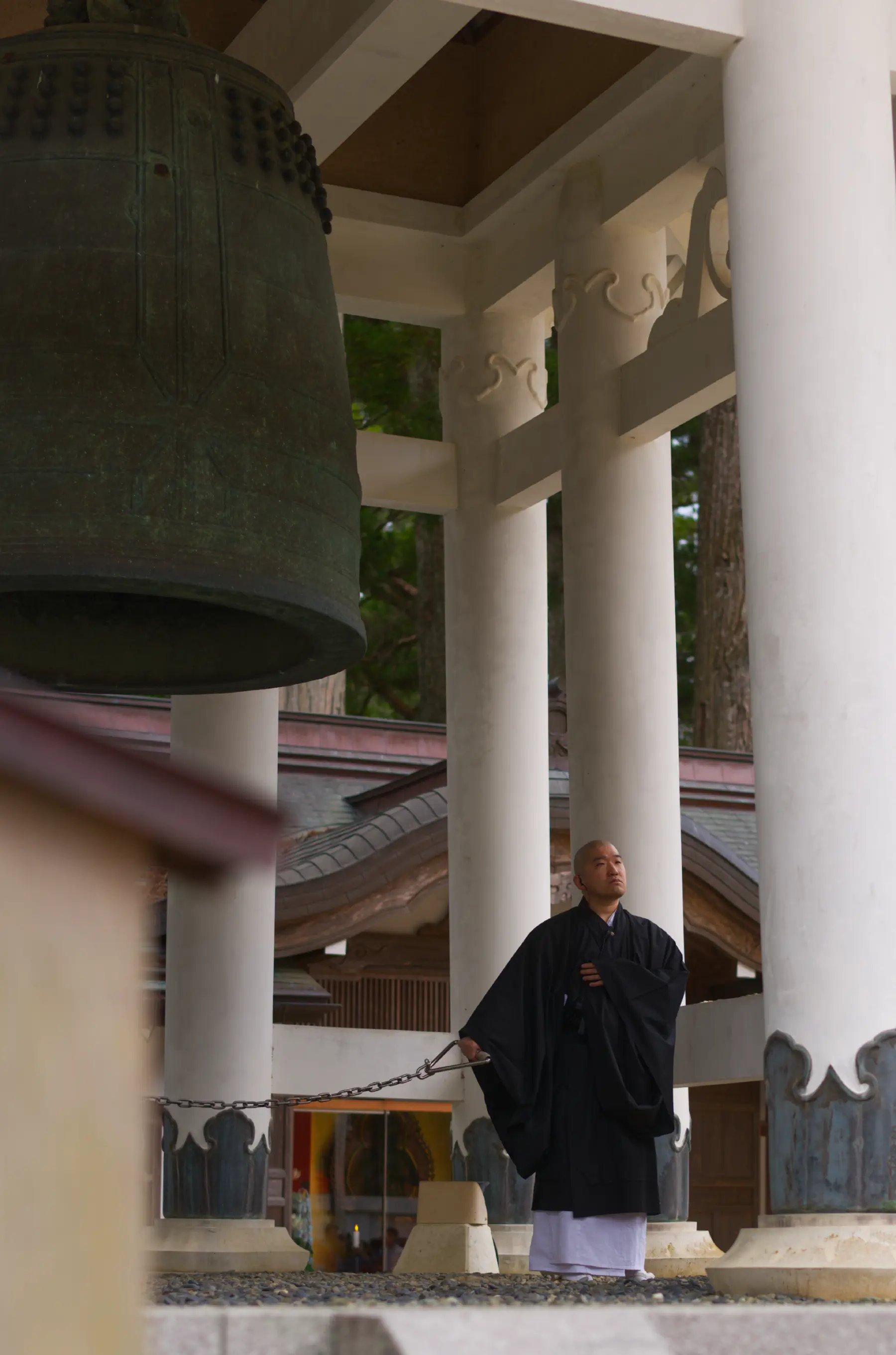
ILCE-7M4,
FE 55mm F1.8 ZA,
f2.5, ISO
100,
1/400
Unfortunately, we did not pray for good weather in the morning, so the afternoon was cut short by a rain shower that lasted until the next morning. Making our way back, we relaxed in our humble room, read some manga, went to dinner, took a bath, and went to bed rather early. Thanks to the morning ritual, we were up since 06:00 after all.
Monday morning. Breakfast, check-out, and off to the next accommodation we go. Again, we were up pretty early, so we had plenty of time to stop on the way down to Nachikatsuura. And that’s precisely what we did.
Nachikatsuura (那智勝浦)—The Onsen in the Cave
The first small stop we took was at the Tanize Suspension Bridge, one of Japan’s oldest and longest wire suspension bridges. Completed in 1954, it held the title for the longest steel-wire suspension bridge in Japan. Until 1994, when the Ryuujin Suspension Bridge in Ibaraki Prefecture was built.
Before its existence, whenever one wanted to cross the pass, they had to cross the Totsukawa River on a log bridge. Whenever this river flooded, that log bridge would go bye-bye. So the people of the region put together around 30'000 yen per household, totaling over 8 million yen to fund the construction of this suspension bridge. For context, at that time, a teacher’s starting salary was only 7'800 yen, and 10 kilograms of rice was 765 yen. It was an enormous investment, but the convenience of the new route was priceless, and the bridge quickly became an icon of the village.
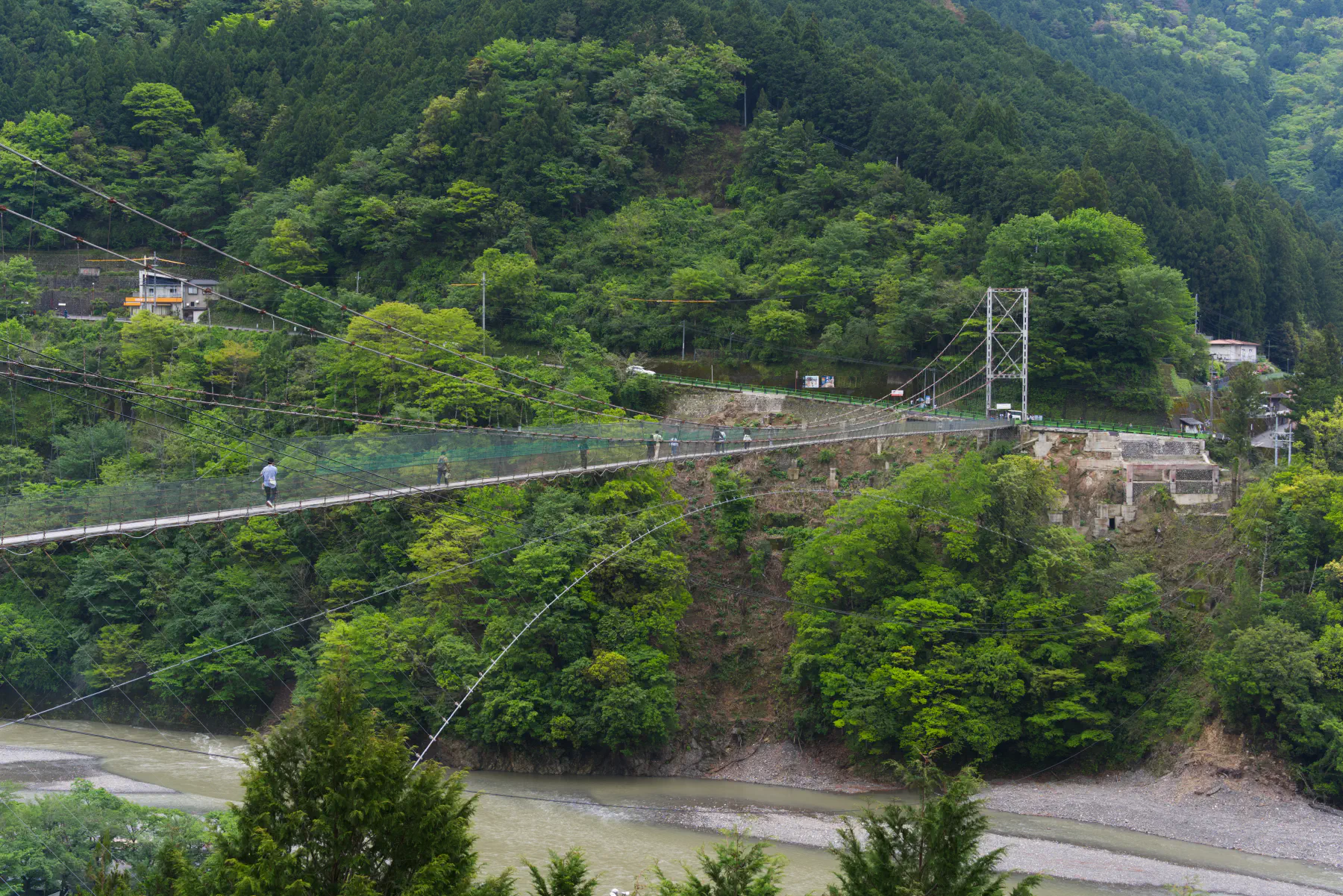
ILCE-7M4, FE 55mm F1.8 ZA, f6.3, ISO 100, 1/60
When we entered the bridge from the south side, a large banner was hanging between the pillars. I don’t have a photo of it, but rereading the Wikipedia article (yeah, sue me for writing correct facts here), it was a notice that no more than 20 people should be on the bridge. That’s not really a lot, so I think we were more than that. But since the security personnel stationed there let us cross without any wait, I guess it was fine?
If you’ve ever walked across a suspension bridge, this one is no different. Swaying is inevitable; some people walked over it like they were on solid ground, while some were reconsidering their choice of crossing every single step. It looked way more precarious than it felt; the wood planks were held together with rusty hooks, some of them brand new while some of them looked like they were from 1954 still.
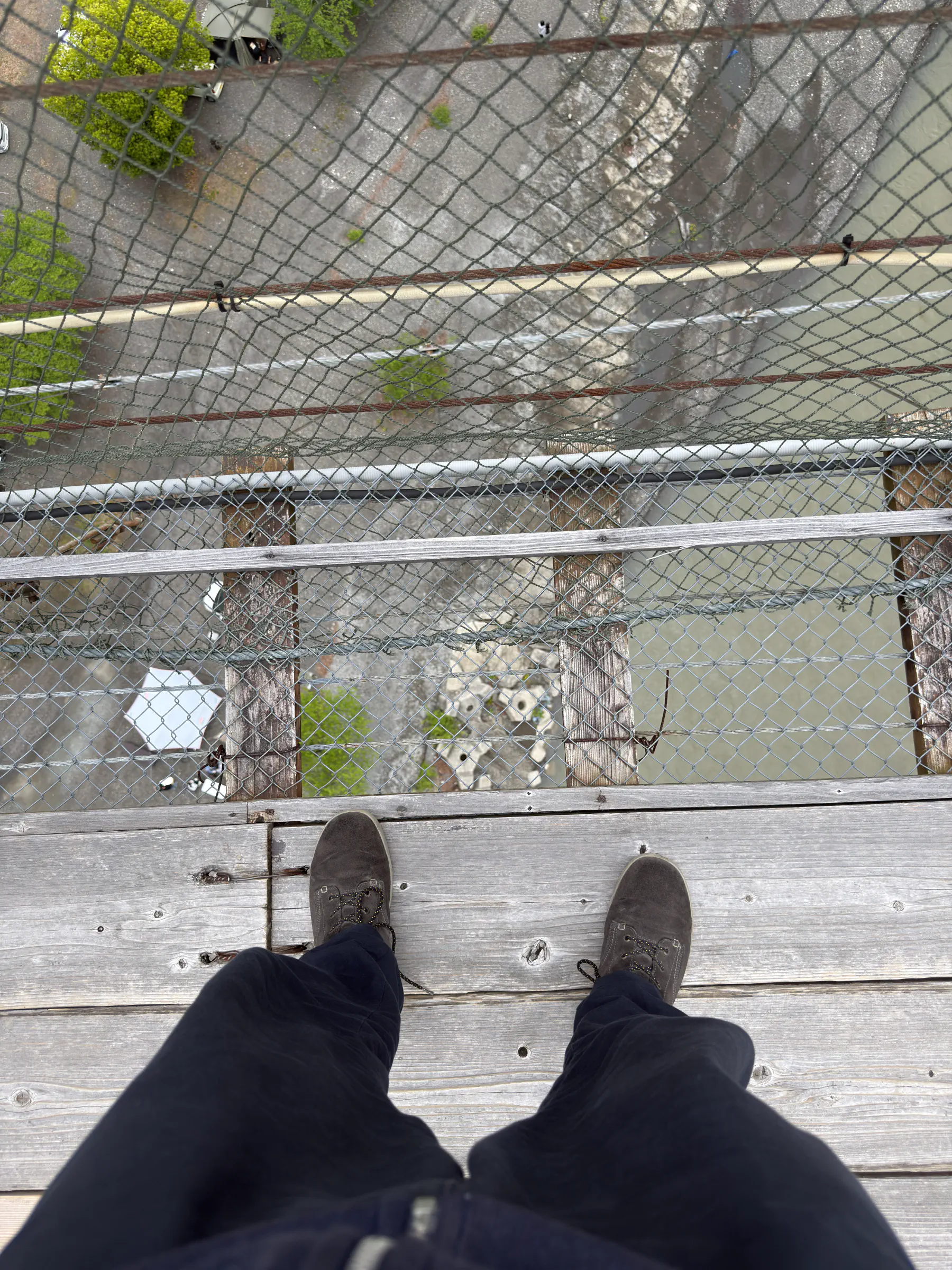
iPhone 16 Pro Max, f1.8, ISO 64
Two relatively quick crossings later, we hopped back into our car and continued driving.
Next up was the Kazeya Dam.
Ever since our camper van trip in 2023, we have made it a staple to stop at some dams whenever we are driving through the Japanese mountainside. Most of them are not really significant, only providing power to a few close settlements. Kazeya Dam is one of those. It doesn’t even have a little shop or museum attached to it. Not even a small cafe. Only a sign that states how tall and how big the water reserve is: 101 meters tall, 330 meters wide, and a capacity of 130 million cubic meters of water. That’s how insignificant it really is.
Anyway, since it was on our way, why not check it out? When we arrived, we were greeted by this sign.
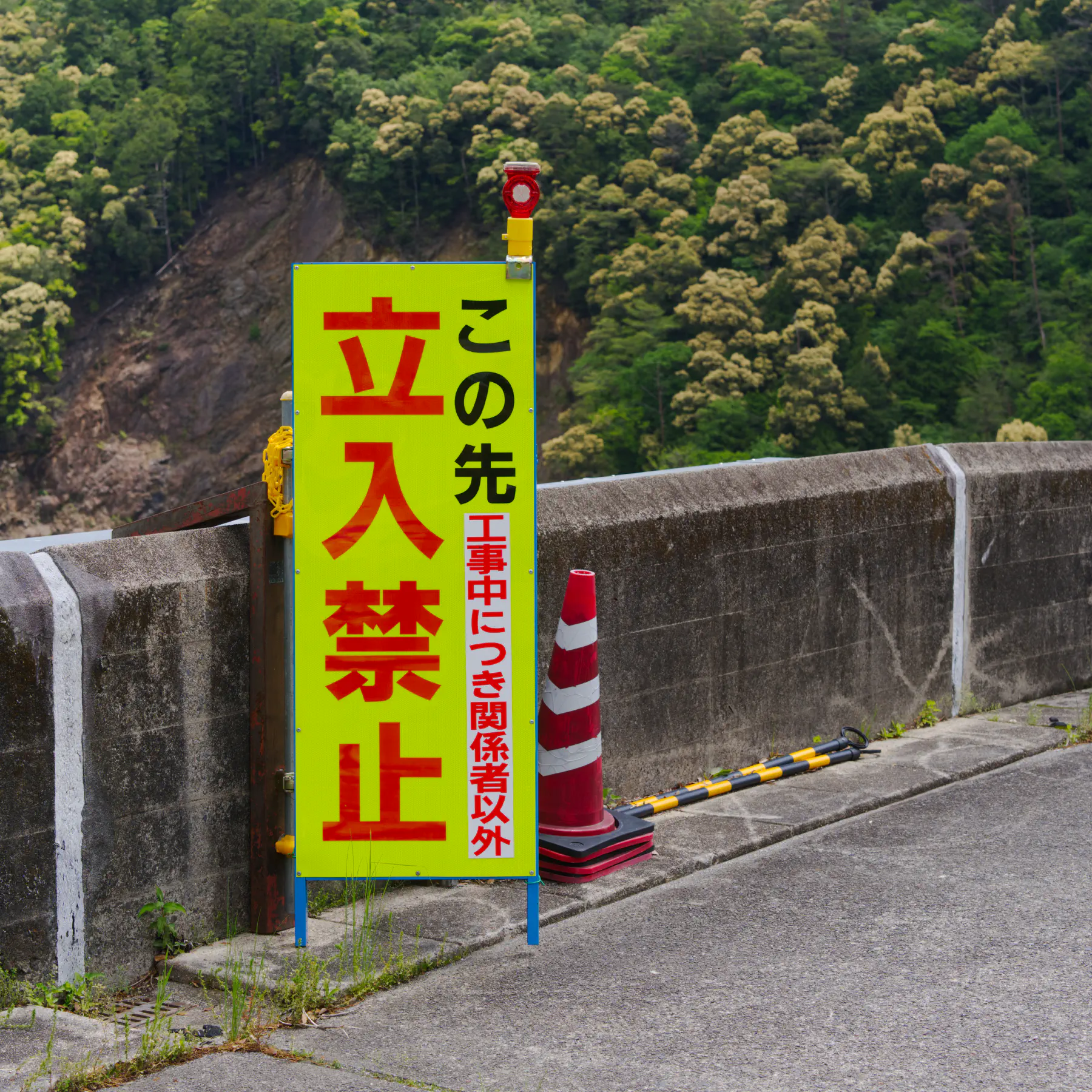
ILCE-7M4, FE 55mm F1.8 ZA, f6.3, ISO 100, 1/500
As a matter of fact, I know exactly what this sign says. The kanjis 立入禁止 mean “Stand, Enter, Prohibition, Stop”. The meaning should be quite obvious: Do not enter! The right-hand part, この先工事中につき関係者以外, can be translated to something like “Construction underway from here; authorized personnel only”.
Interestingly enough, we did not see any construction work anywhere. No barriers, no workers, no equipment, nothing. So did we trespass to get some nice pictures? Not at first. But it didn’t take long for another Japanese person to arrive, read the sign, look around, and, without thinking twice, just walk ahead on the dam to also take pictures.
When in Rome, do as the Romans do.
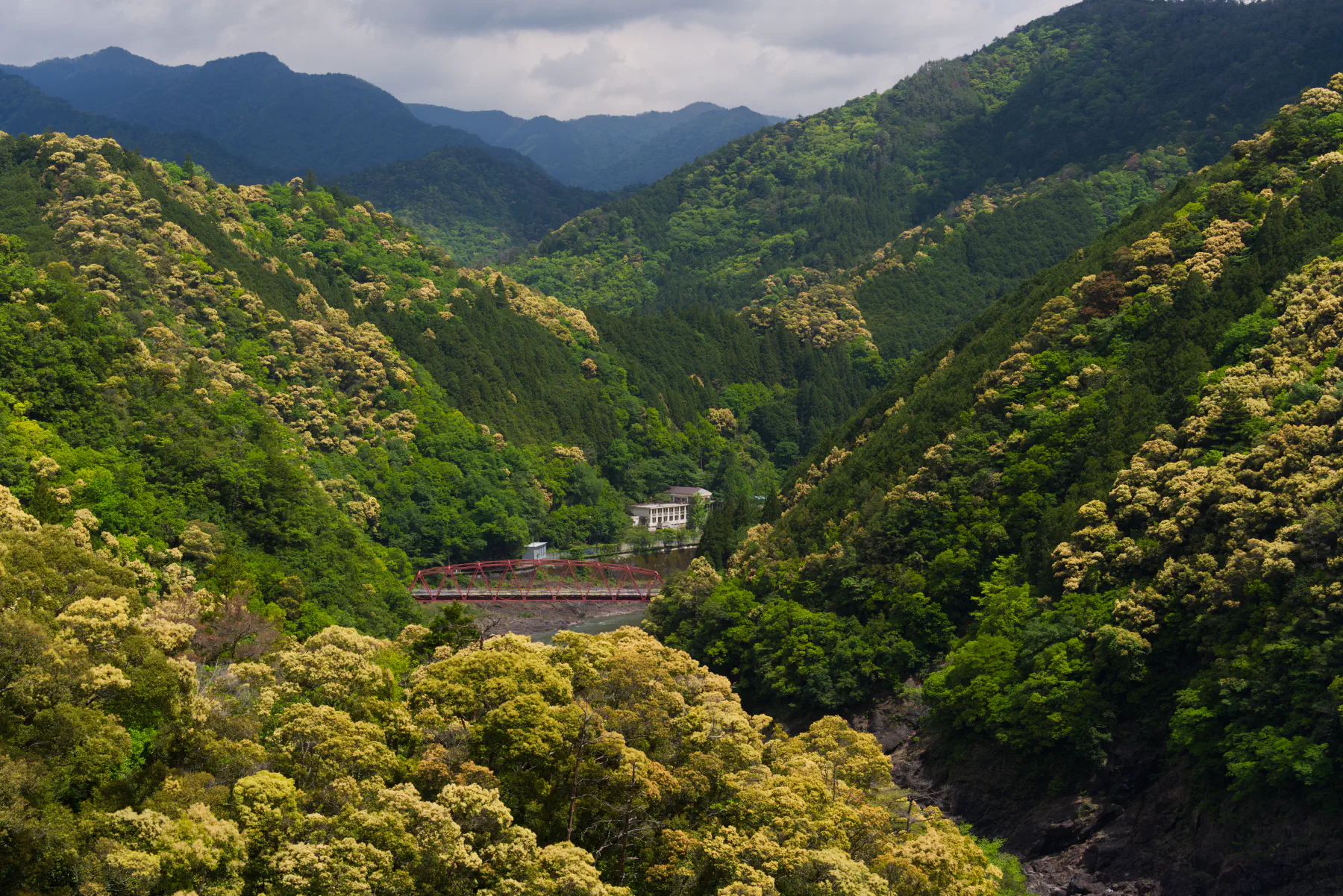
ILCE-7M4, FE 55mm F1.8 ZA, f6.3, ISO 100, 1/500
With these pictures taken, we drove onward to the final destination of the day. The parking lot of the Urashima Hotel.
Because the hotel is on a small, narrow peninsula, there is no parking right beside it. The parking lot is quite a distance away, but they offer a free and frequent shuttle service. So we parked, rode the shuttle bus, checked in, and voila, this was our room for the next night.
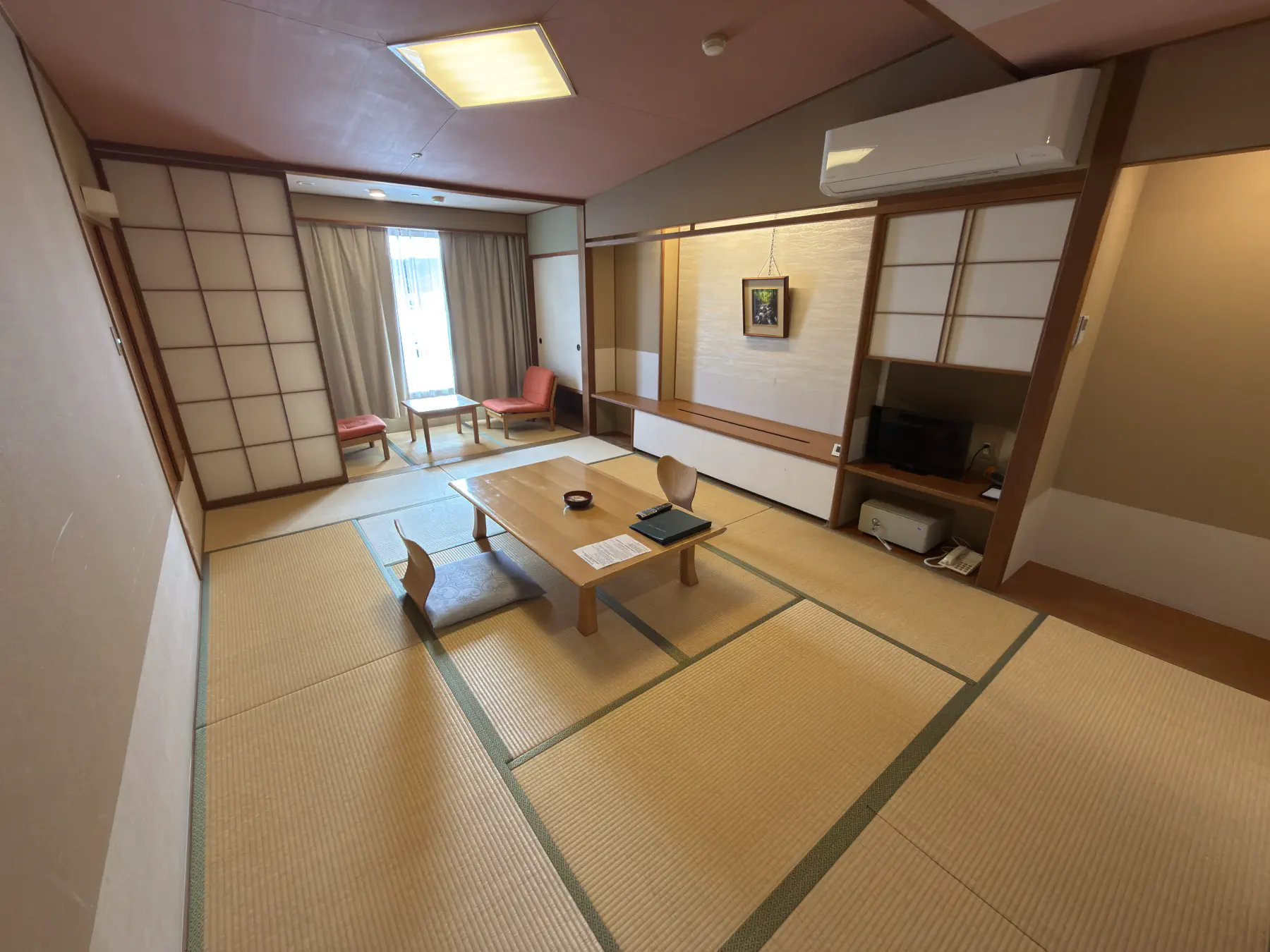
iPhone 16 Pro Max, f2.2, ISO 64
This hotel was a huge complex, with multiple baths, shops, and even a Lawson convenience store right next to the lobby. This one wasn’t open 24/7, as is usually the case. Because there were some renovations going on, and also because we only stayed for one night, we only had the chance to visit one onsen: the one in the cave, where you can go outside and have a great view of the sea if it’s still bright outside.
Guess what we did.
Without much thinking, we went after dinner, so everything was pitch black with only a few lights sparkling on the horizon. It might have been the other shore; it might have been ships that were out on the sea.
Except for smelling like rotten eggs, thanks to the presence of sulfur in the volcanic water, the bath hit the spot after a long drive.
Like I said in my last post, there’s nothing better than relaxing and chatting in a hot bath.
Relaxed, we quickly stopped by the Lawson store, bought some alcoholic refreshing drinks, and enjoyed them in our room until we went to bed.
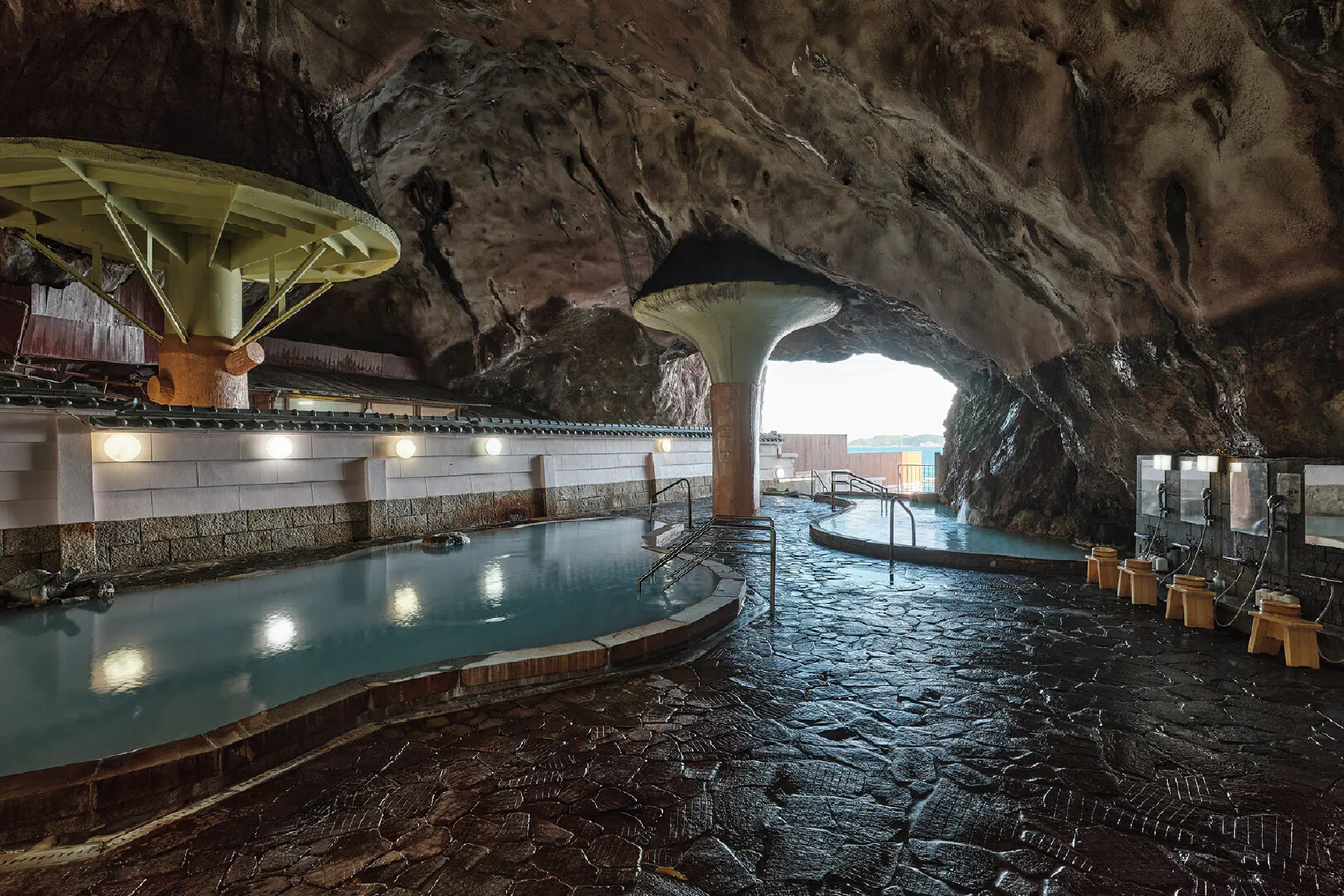
The next day, after breakfast, my friend decided to hop in for a quick morning bath. This time the women and men side were flipped, but, according to him, the view was just about the same.
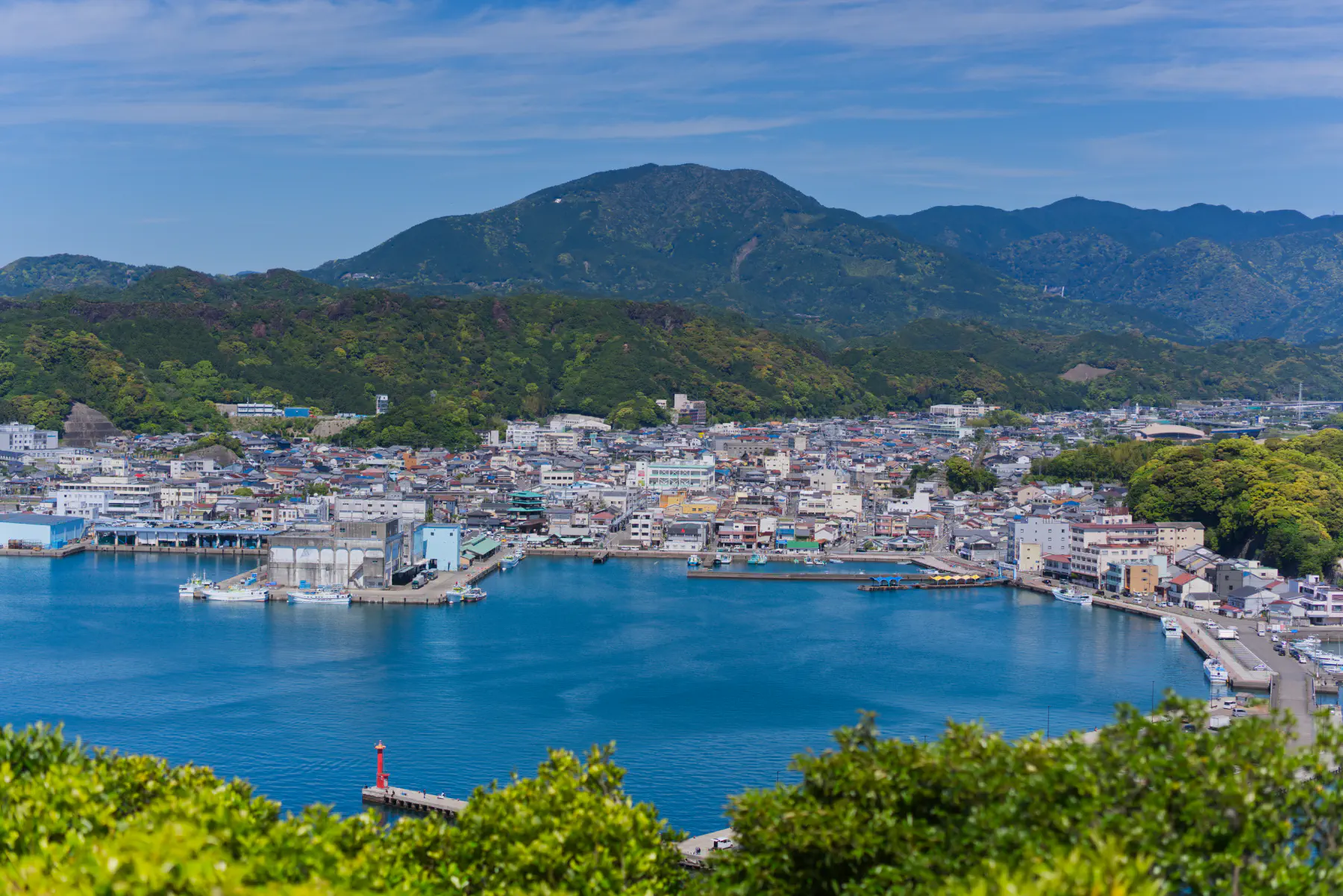
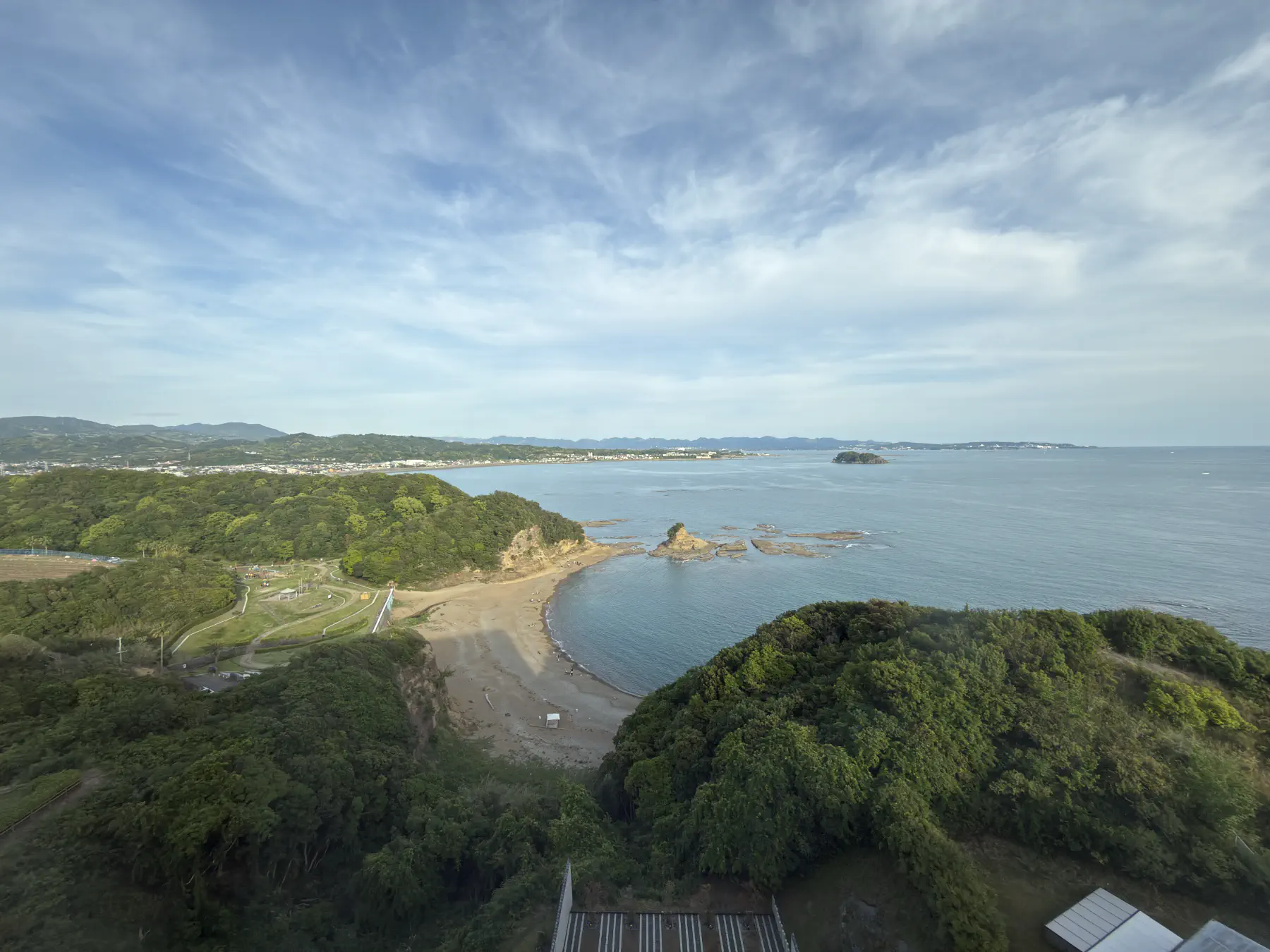
As written above, this hotel was gigantic. Thanks to this, after checking out, we walked through the whole complex, took an elevator to the top, and walked again until we finally ended up on the roof. Take a look at this fantastic morning view.
ILCE-7M4, FE 55mm F1.8 ZA, f2.8, ISO 100, 1/5000
From here we saw the famous waterfall named Nachi no Taki (那智の滝), which we totally missed on our drive here. It’s even included in the picture above; can you spot it?
Our cameras filled with images from the sea, we went back down, took the shuttle bus to the parking lot, and continued our drive. Let’s go down south, to the southernmost part of Honshu.
Kushimoto (串本)—The Southernmost Part of Honshu
Did you know that right here in Kushimoto, there’s a commercial spaceport?
Now you know it, and only a few days later than me.
Spaceport Kii is Japan’s very first private spaceport, operated by Space One. Space One is developing a solid-fuel rocket named KAIROS (Kii-based Advanced & Instant Rocket System), designed to launch small satellites into low orbit. As of this writing, they’ve had three launches so far, which, unfortunately, all ended in premature flight terminations. Translated, this means the rocket went kaboom to not let it fly around uncontrollably.
Since the Spaceport Kii is a private spaceport, one cannot simply walk up to it to take pictures. Additionally, the KAIROS rocket is only 18 meters tall, so the spaceport is very small and almost hidden in the thick forest. I was constantly checking my map, but we drove by it instantly, with no building to be seen.
Instead, we went to the Sora-Miru Space Museum. It was fairly small and primarily aimed at children, having interactive quizzes and puzzles and even a place where you could draw your satellite, scan it, and have it be projected on the roof overhead.
From something completely man-made to something only nature could do. The next stop was the Hashiguiiwa Rocks.
Do you remember Kōbō-Daishi? I hope you do. Legend has it that Kōbō-Daishi made a bet with a Yōkai, a supernatural spirit in Japanese folklore, that he could build a bridge to the Kii Oshima Island in a single night. Still during the night, the Yōkai mimicked a rooster, tricking Kōbō-Daishi into thinking dawn had already arrived, leaving this “bridge” incomplete.
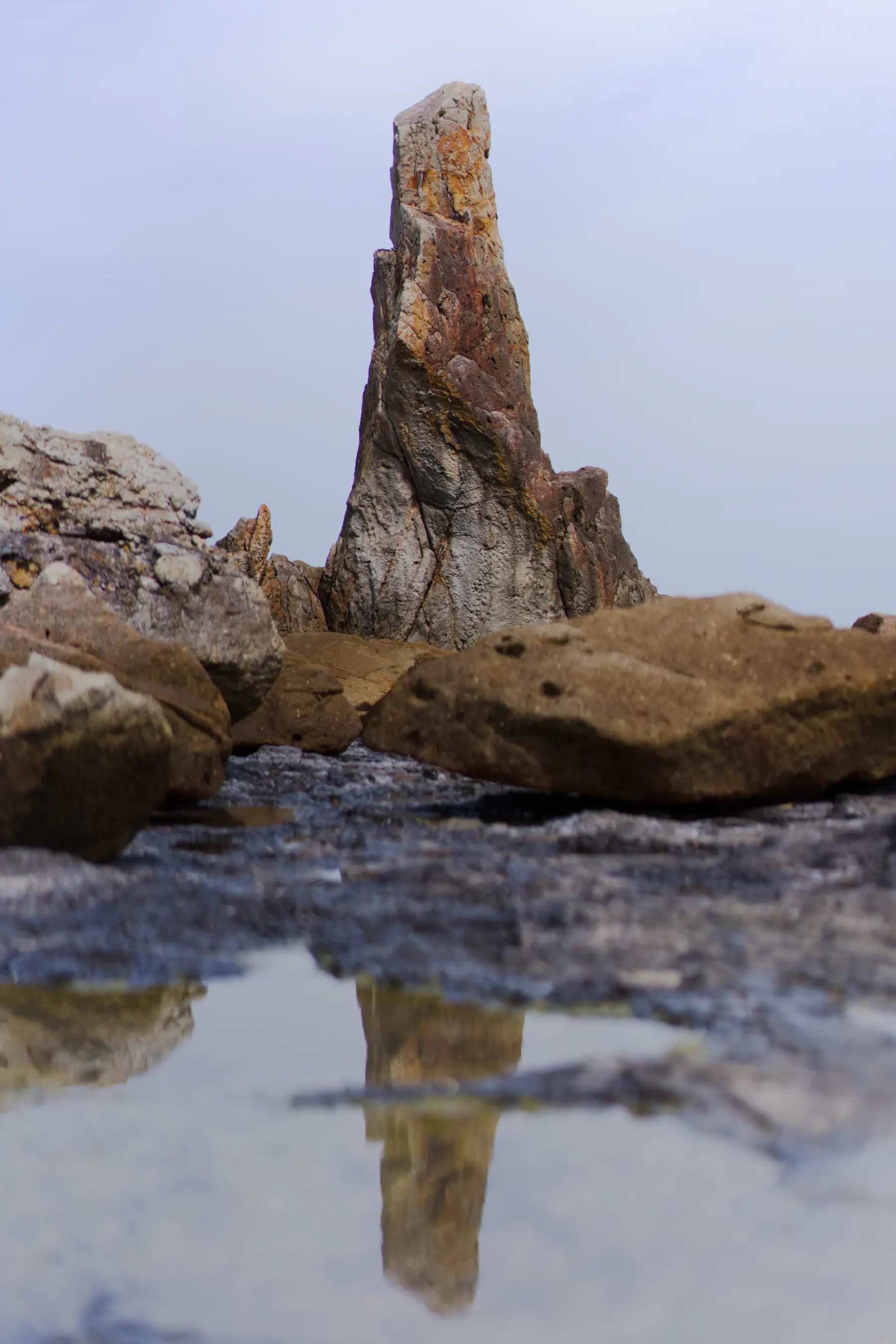
From a scientific view, these rocks were formed by volcanic activity some tens of millions of years ago. Magma shot up into the mudstone, hardened, and then the mudstone got eroded by waves, leaving only the hard sections standing. There are dozens of these pillars sticking up, neatly forming a line in the direction of Kii Oshima Island.
There were many people, and I don’t like taking pictures that have random people in them, so I implore you to check it out on Google Maps. From above, it really looks like Kōbō-Daishi did try to build that bridge.
ILCE-7M4, FE 55mm F1.8 ZA, f1.8, ISO 100, 1/8000
It’s a really cool sight. I’m super happy with this picture; the reflection, the lack of other people… I really think it’s one of the best shots I’ve taken so far.
When we arrived, the tide was very low. With a lot of the rocks exposed, we could even walk over to a small shrine that sits on the small island right next to the shore. A quick trip up and down, the tide already started to come in. So, not wanting to get stranded, we quickly walked back and continued our drive.
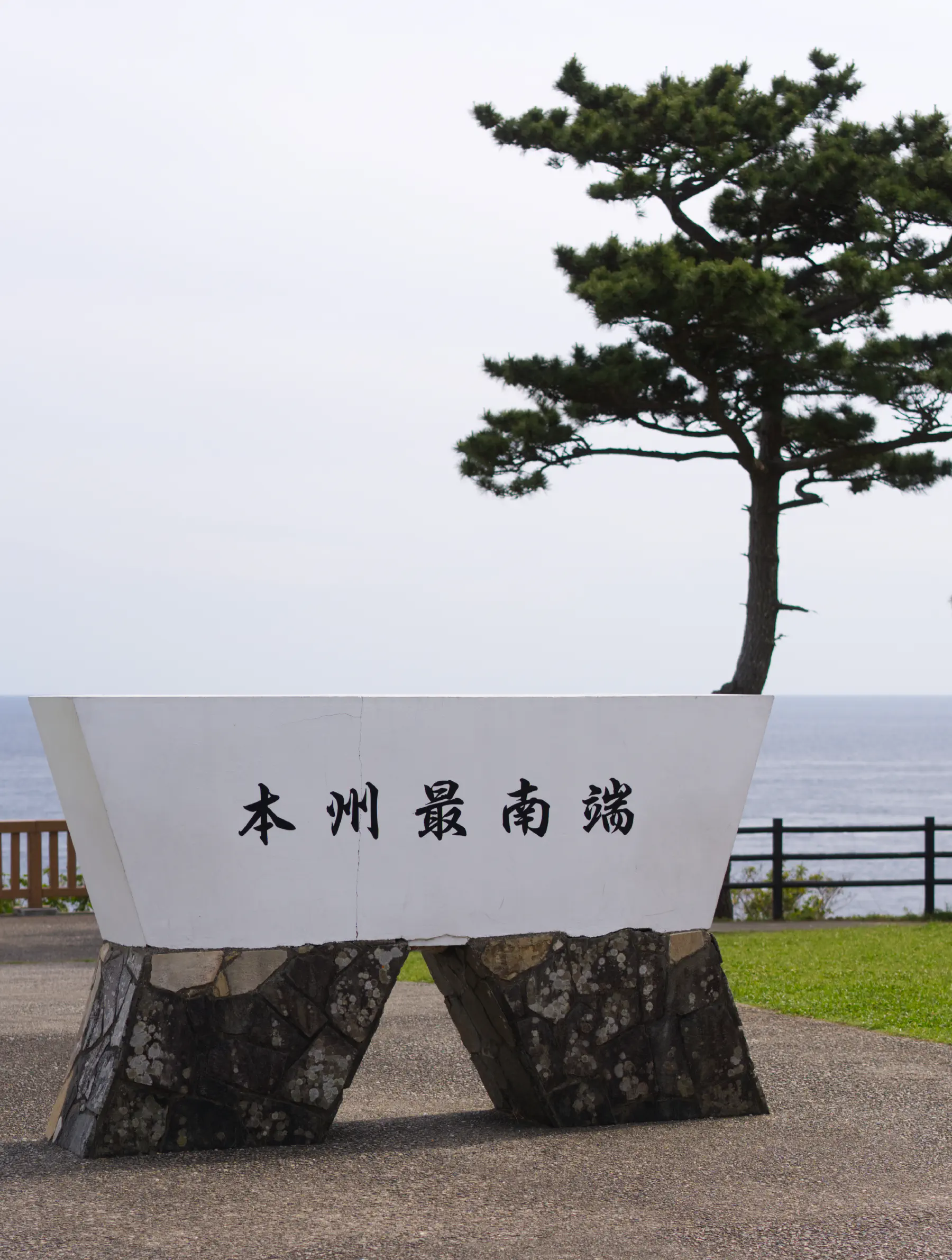
Not much further now; just a few meters away and we will arrive at the next stop. The southernmost point of the Japanese main island, Honshu.
Japan consists of over 14'000 islands, of which 260 are inhabited. The main islands are Hokkaido, Honshu, Shikoku, and Kyushu. Fun fact: Kyushu, the southernmost, is roughly the size of Switzerland.
But we are still on Honshu and at the southernmost point of it. Not the southernmost I’ve ever been; that still belongs to Kagoshima, but this was a quick detour on our way to the next hotel.
ILCE-7M4, FE 55mm F1.8 ZA, f3.2, ISO 100, 1/4000
The monument itself is on a cliff, overlooking only the sea, with a few ships sprinkled on it. In this direction, there is no land until Papua, a little less than 4'000 km to the south.
We still had quite the drive in front of us, back up the western shore to Minabe, where we stayed in a pretty fancy hotel. We weren’t the only ones, though, as the large parking lot was already almost full and the lobby fairly crowded with people. Nevertheless, check-in was smooth, we relaxed a bit, then went out to town to finally, for the first time in almost 2 months, eat sushi.
iPhone 16 Pro Max, f2.2, ISO 16
When we came back, the parking lot was indeed full, so we did what other people did and just parked on the lot where we wouldn’t block anyone’s way. As usual, a hot bath after dinner, a refreshing drink, and to bed we went.
A refreshing sleep later, we went onward to our last destination: back to Matsubara, but not before stopping at something we’d seen the evening before:
Kishi Station (貴志駅)—The Station Manned by a Cat
It’s 2004. The Kishigawa railway line that is winding through Wakayama is on the verge of bankruptcy due to way too few commuters to make it sustainable. A calico cat named “Tama” that was strolling around every day soon became a permanent feature. Even the locals jokingly called her the “Stationmaster”. When the railway company changed hands, the new owners, Wakayama Electric Railway, took this joke to heart and, in 2007, officially appointed Tama as the stationmaster of Kishi Station. Thanks to Tama, the passengers riding the Kishigawa line increased by almost 20%, and it was estimated to have contributed around 1.1 billion yen to the local economy. That’s the Nekonomics hard at work. (Neko, 猫, cat).
In 2010, Tama was promoted to “Operating Officer” and as such was the first cat to become an executive of a railroad corporation. Also with this, the station was rebuilt to resemble a cat’s face, with eyes in the roof and cat ears on it. And yes, there’s also a cat-themed train that you can ride on this line.
After Tama’s passing in 2015, she was enshrined at a nearby cat shrine, and after the traditional fifty-day mourning period, her successor, Nitama (Ni, 二, two), took over. This naming scheme continued until today; Yontama (Yon, 四, four), Gotama (Go, 五, five), and Rokutama (Roku, 六, six) are all ready to welcome you to Kishi Station.
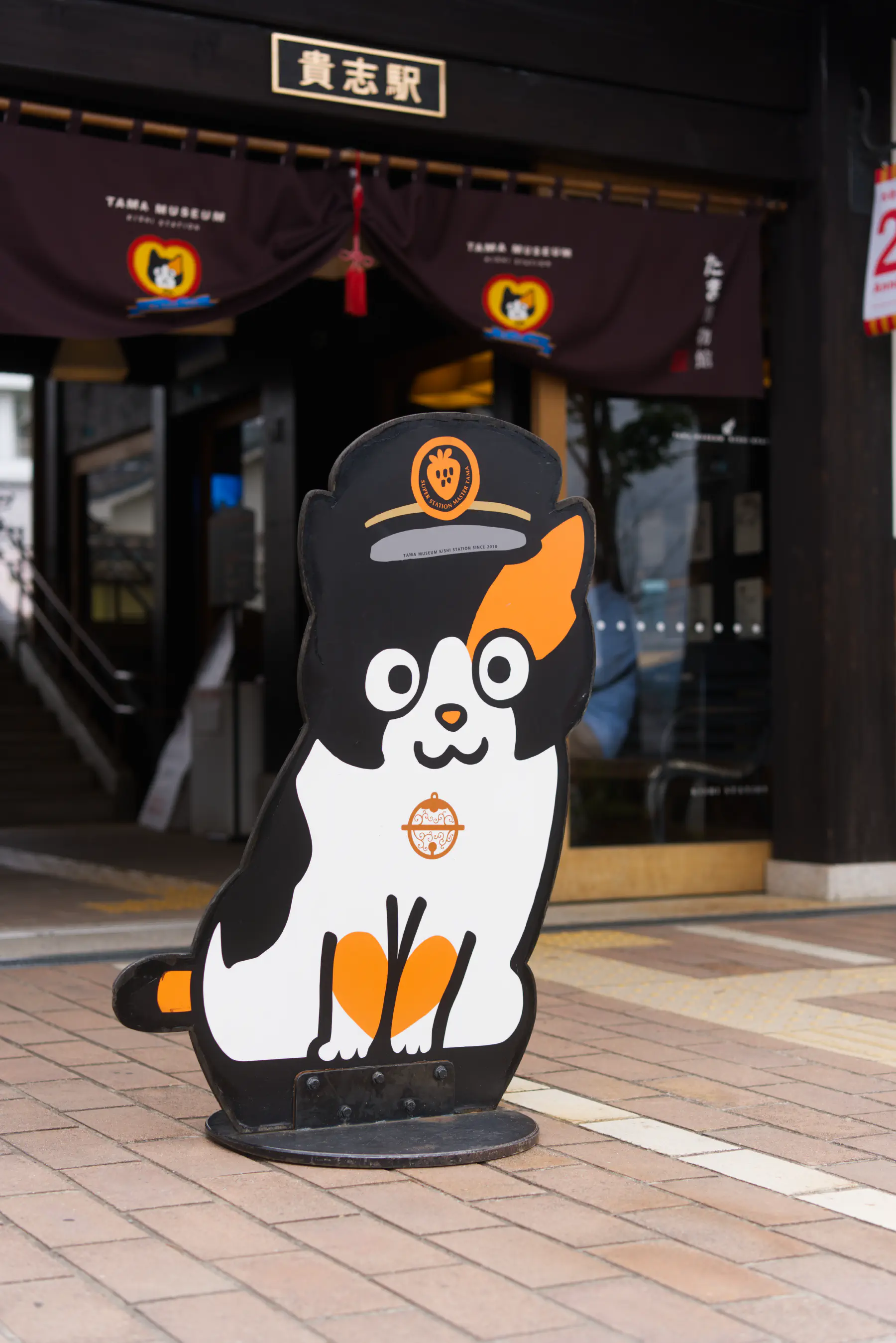
ILCE-7M4, FE 55mm F1.8 ZA, f3.2, ISO 100, 1/640
This was a fun little detour on our way home. Tucked away in the mountains of Wakayama, you really wouldn’t know that there is a super popular cat-themed train station. Even their website lets you know that these cats are the superstars here. On the front of the Wakayama Electric Railway website, there is a small drop-down you can open up, revealing the “Stationmaster’s Schedule”. As written, we went to Kishi station, where Yontama is stationed. Gotama works at Idakiso station, while Rokutama mans both of them when the others have their day off.
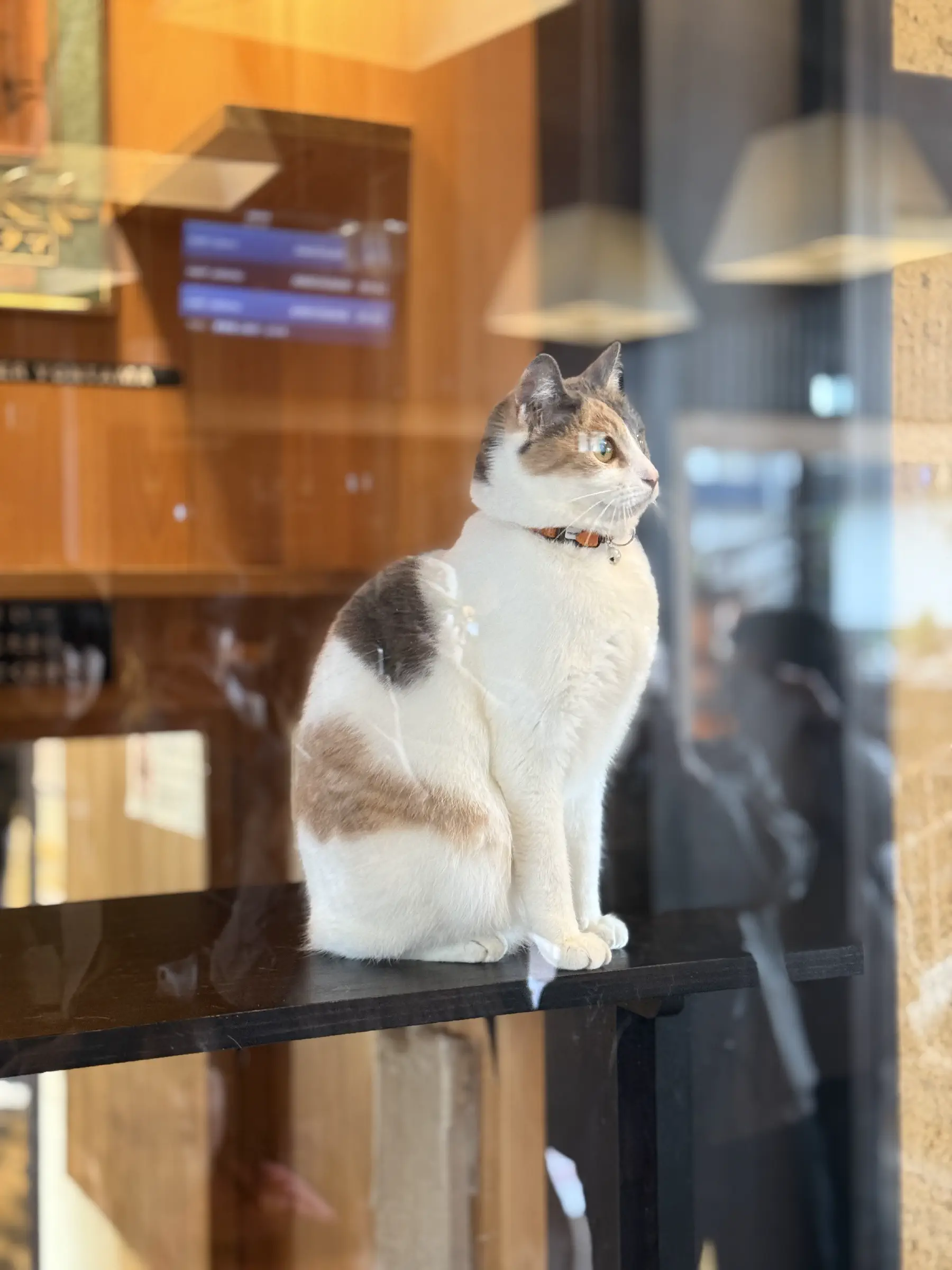
iPhone 16 Pro Max, f1.8, ISO 250
Of course there’s also a souvenir shop, carrying T-shirts, postcards, models of cats, models of trains, mugs; and, and, and… As soon as we walked into the shop, we both knew that we would be spending money here.
After having stocked up on cat-themed goods, we drove the last part to Matsubara, returned the car, and made our way home.
What’s Next?
As of the time of this writing, I have 3 more weeks of school and 2 weeks of vacation remaining. It’s fun picking out pictures, touching them up, and writing about stuff we experienced, but it also takes a lot of time. I’ll probably write again about the last two weeks of vacation we have, but that’s most likely going to be finished when I’m back in Switzerland.
There are two ideas I have for non-trip-related posts; perhaps keep an eye out for those. You could say that one of them is about a short afternoon trip, while the other is about the language itself.
But first, I’m going to reread this post for any errors and publish it.
Thank you for reading, and until next time!